 ultimate-guide
Best Tips for Busking in Australia: 2026 Guide
Updated 14 October 2026
The best tips for busking in Australia start before the first note: check the rules for your exact pitch, prepare an act you can deliver confidently, and make it easy for people to stop, enjoy it and support you.
A busy street alone does not guarantee a good session. You need somewhere you are permitted to perform, enough space for an audience, suitable sound levels and a setup you can carry and pack down without stress. This guide covers those decisions, with practical ideas for musicians and other street performers.
1. Check the rules for the exact place you want to perform
Start with the council or organisation responsible for your intended pitch. Do not assume permission for one part of a city covers every shopping precinct, transport station, park or privately managed space nearby.
Read the current policy and any location map before applying or travelling. If something is unclear, describe your act and proposed equipment to the relevant team and ask for written clarification.
Your checklist should cover:
- Whether a permit, licence, registration or separate site permission is needed.
- Which category covers your act, including any assessment or audition.
- Approved pitches, restricted areas and temporary closures.
- Amplification, backing tracks, sound levels and permitted hours.
- Session limits, breaks, pitch rotation and sharing arrangements.
- Any conditions for group acts, young performers, props, insurance or selling merchandise.
Examples from Melbourne, Sydney and Brisbane
The following examples were checked on 14 October 2026. They show why local guidance matters; they are not a complete list of conditions or a substitute for your permit.
Location | What the official guidance says | What to do before your session |
|---|---|---|
City of Melbourne | A permit is required to busk. Applicants under 16 need parent or guardian consent. | Read the busking permit requirements and confirm which permit suits your act. |
City of Sydney | The busking code distinguishes low-impact, high-impact and extended-duration acts. Special sites have additional rules. | Use the current code and digital guide to check your act type, suitable pitches and closures. |
Brisbane’s Queen Street and Valley malls | A busking licence requires a successful audition. The published mall rules prohibit amplification and electronic performance devices, including amplifiers, keyboards and electric guitars. | Read the mall busking conditions before planning an amplified act. |
For anywhere else in Australia, repeat the same check with the relevant authority. A recommendation from another performer can help you find a pitch, but confirm the conditions yourself.
2. Choose a pitch where people can stop comfortably
Assess a permitted location before unpacking. Watch how people move through it: do they have room to pause, or are they hurrying through a bottleneck? Imagine where a small audience would stand and whether pedestrians could still pass.
Keep entrances, accessible routes, crossings and emergency access clear. Place cases, signs and cables within your permitted performance area. A crowd should be able to watch without stepping into traffic or blocking someone’s route.
Listen as well as look. Nearby musicians, shop speakers, construction and traffic may make a pitch unsuitable for your act. Trying to overpower competing sound can create a poor experience for everyone.
Try a few permitted time slots and record the results. Lunch periods and weekends can be useful experiments, but there is no universally best hour. Weather, events and the character of the location can change the audience from one day to the next.
3. Pack for your act, not an imaginary perfect setup
Begin with equipment you can manage reliably. An acoustic performer, a living statue and a juggling act will have different needs. An amplifier is optional equipment, and only belongs in your kit where it is permitted.
Pack or prepare | Practical check |
|---|---|
Instrument, costume or performance props | Inspect anything that could fail during the act; carry the spares you actually use. |
Permit and relevant conditions | Keep them accessible in the required format. |
Sound equipment, if allowed | Test cables, levels and runtime together before leaving. |
Phone and charging plan | Leave enough charge for travel, communication and checking payments. |
Support sign and cash container | Make the sign readable, scan-test the QR and keep the collection point secure. |
Weather and personal essentials | Check the forecast and pack water, suitable clothing and protection for your gear. |
Transport and packing plan | Make sure you can move everything safely if conditions change. |
Rehearse the pack-down as well as the performance. Knowing where every cable and prop goes makes it easier to leave on time and keeps small items from being left behind.
4. Build a short performance that has a clear beginning and ending
A street audience can arrive halfway through a song or leave before your final trick. Give people several easy entry points rather than relying on a long introduction.
For musicians, one possible sequence is:
- Open confidently. Choose something you perform well and can begin without a lengthy setup.
- Offer a contrast. Change the tempo, texture or mood so the next piece feels distinct.
- Show your identity. Introduce an original or a favourite arrangement with one short sentence.
- Finish clearly. Give the piece a deliberate ending, acknowledge the audience and explain how they can find or support you.
This is a rehearsal template, not a proven formula for earnings. A comedy, dance or circus act may work better as a compact routine with a visible payoff. Choose a structure that suits your skill and the permitted conditions.
Let local time limits set the outer boundary. Within that, choose a length you can sustain comfortably. There is no universal 30- or 45-minute rule for successful busking. Prepare material you can shorten or extend without overrunning your pitch allocation.
5. Invite attention without demanding it
Start when you are ready, even if nobody has stopped yet. Face the space where people can safely gather, and acknowledge those who choose to watch. A smile or a brief thank-you can fit between phrases without interrupting the whole performance.
Keep spoken introductions short enough that someone arriving midway can understand what is happening. Avoid calling out people who walk past or making a person feel obliged to pay because they watched.
If an audience grows, keep checking the space around it. Pause or adjust if people are obstructing a route. Sharing a public place well matters as much as holding attention.
Respect nearby performers too. Follow the local rotation rules, agree practical handovers where appropriate and avoid setting up so close that the acts compete for the same listening space.
6. Offer a clear way to support you
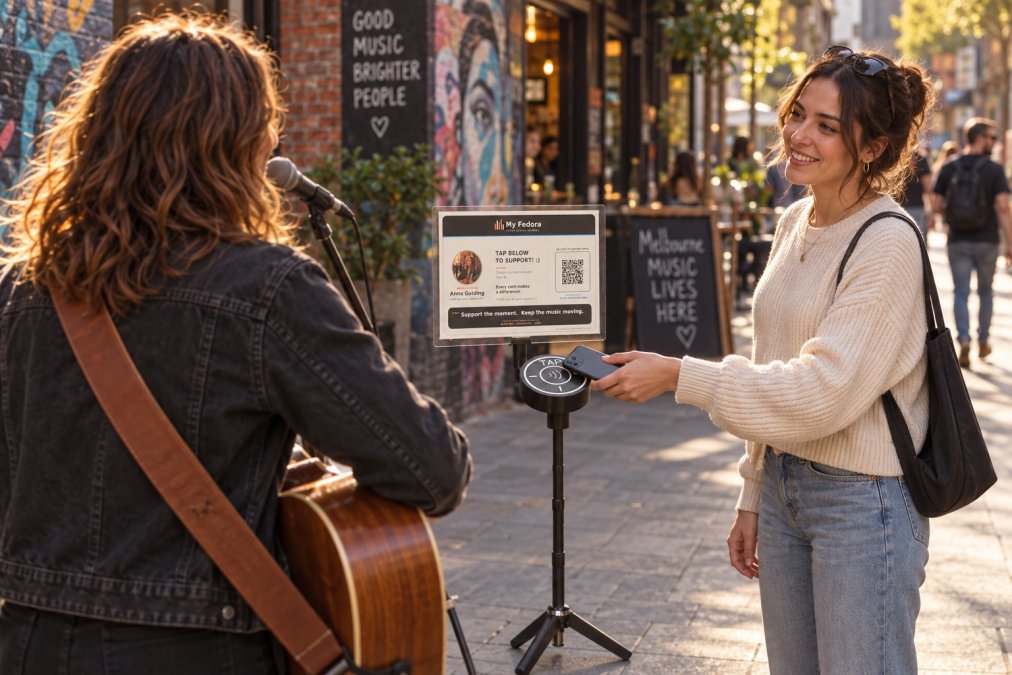
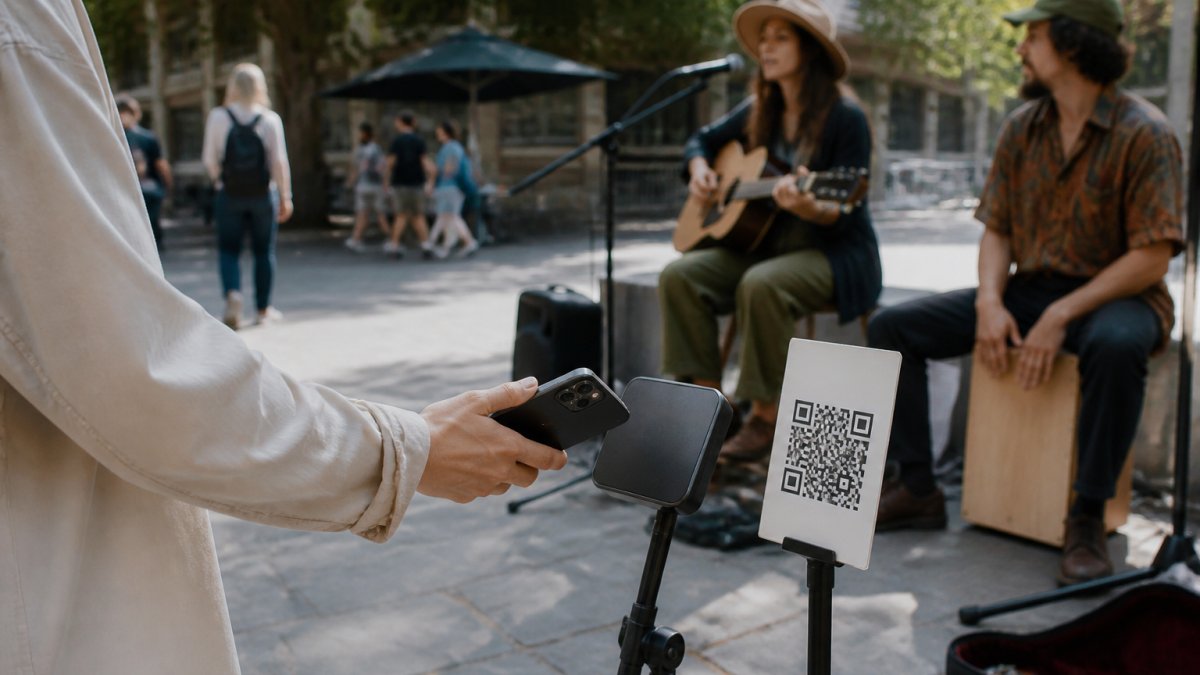
A cash container serves people carrying notes or coins. A visible QR code gives people with an internet-connected smartphone another option. Choose one clear primary sign rather than surrounding your act with competing instructions.
Place it where a supporter can reach it without leaning over your instrument or entering the performance area. Test it at the intended distance and in outdoor light; a code that works on your laptop screen may be harder to scan once printed behind a reflective sleeve.
A simple spoken invitation is enough: “Thanks for listening. If you’d like to support the set, you can scan the code here.” Keep the invitation voluntary and return to the performance.
How My Fedora and Halo Pulse fit
My Fedora provides an artist profile and an online support checkout. Your support QR opens the checkout directly. You can display a printed QR without purchasing Halo Pulse, provided your payment setup is complete and working.
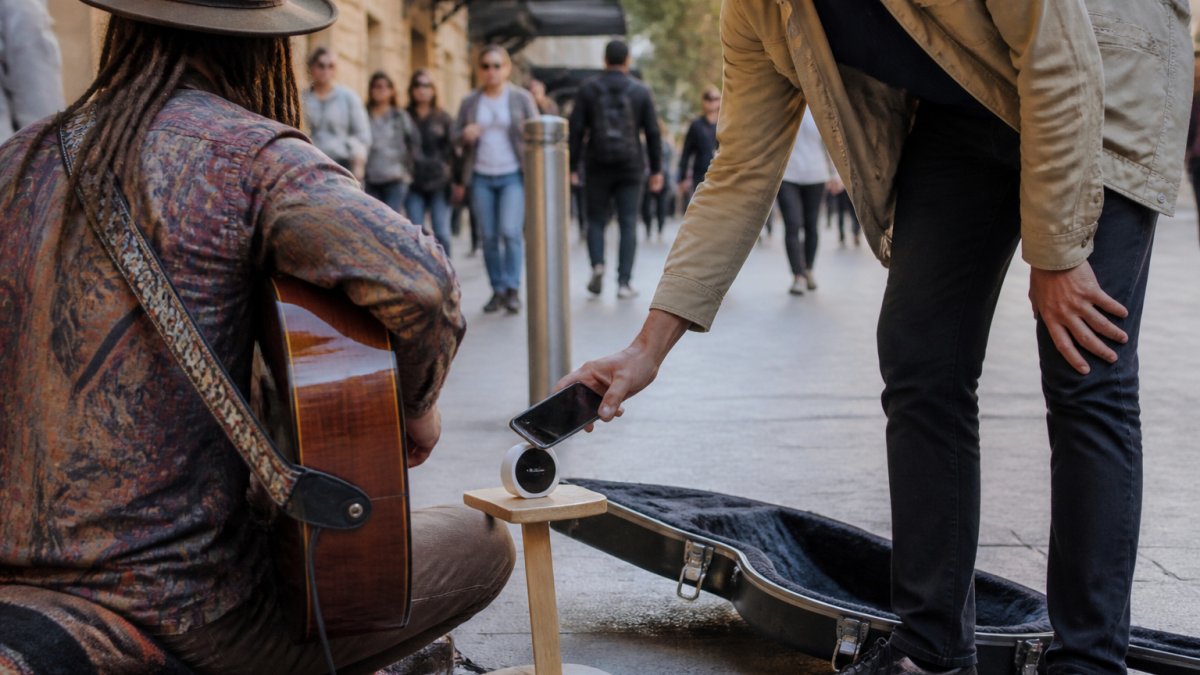
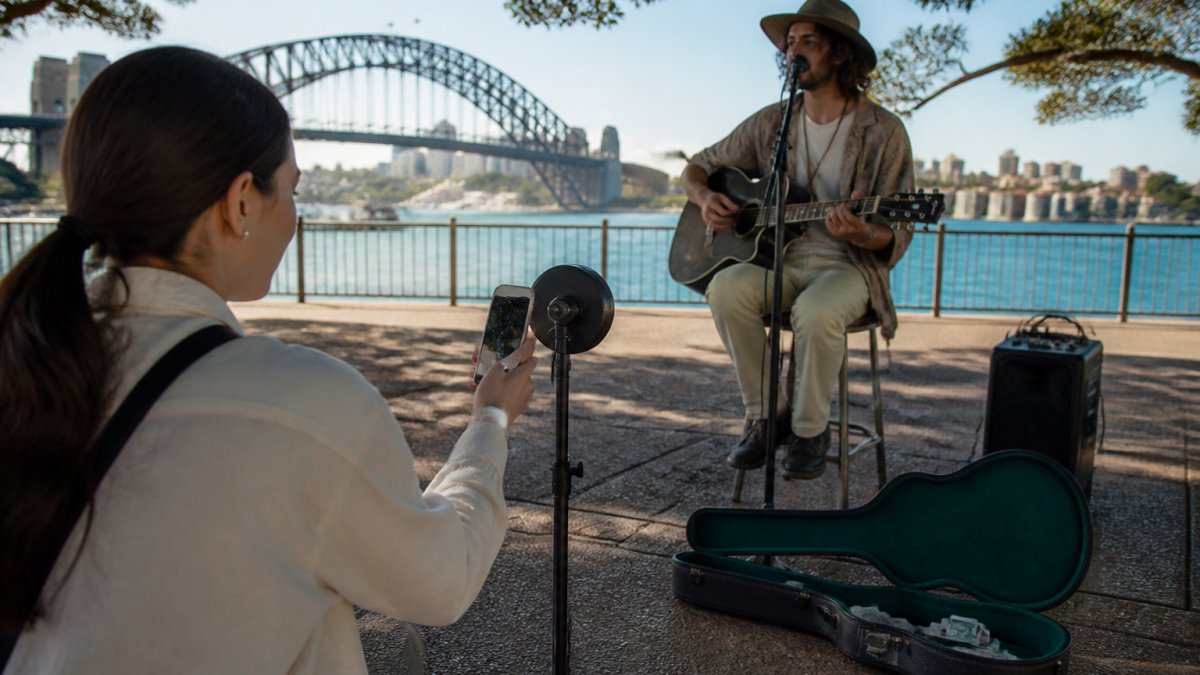
Halo Pulse adds a smartphone NFC/QR access point. A supporter taps a compatible smartphone to open the link, or scans the QR, then completes checkout on their own phone. Use a clear instruction such as “Tap your phone to open the link.”
Halo Pulse is not a bank-card reader. It does not store card details or create or queue offline transactions. The supporter’s phone needs internet access; mobile data can work without public Wi-Fi. Opening the link is the start of checkout, not proof that a payment has completed.
My Fedora deducts 0% from the selected artist-support amount. Ordinary payment-provider fees may apply. Any additional supporter contribution to My Fedora is optional and unchecked by default.
If you are still comparing setups, our busking payment apps guide explains the differences between online QR checkout, smartphone NFC links and contactless card acceptance.
7. Make it easy for a listener to find you again
Display your artist name clearly and keep it consistent with your online profile. Someone who cannot stop today might still want to look you up later.
Separate the purpose of each link. A support QR should make its destination clear; your profile or social handle gives people somewhere to explore your music, see your work or contact you afterwards. Do not imply that paying automatically subscribes someone to updates.
Before the session, review your public profile on a phone. Check the photo, short biography and links, then remove anything outdated. Our digital profile guide for street musicians can help with that preparation.
8. Review the session without judging it by one tip total
Keep a short log after packing down. Note the pitch, time, weather, act length and any equipment or checkout problems. Add a few observations: which pieces held attention, whether people could read the sign and whether your breaks felt sufficient.
Record cash and confirmed digital support separately. Check the payment provider’s records and distinguish a successful transaction from a bank payout. Allow for fees and session expenses when reviewing what you earned.
Change one thing at a time where practical, such as the opening piece or sign position. Comparing similar sessions gives you more useful feedback than assuming one busy afternoon proves that a new setup always works.
Keep valuables secure, arrange a check-in with someone if useful, and leave if a location or situation feels unsafe. Stop and pack down when weather or equipment conditions make continuing impractical. A session you can repeat comfortably is a better goal than forcing a long performance.
Your next-session checklist
- Confirm permission, pitch conditions and any closure alerts.
- Prepare a manageable performance with a clear ending.
- Test your equipment and printed support sign.
- Leave enough room for both the audience and passing pedestrians.
- Check the forecast and plan your journey home.
- Afterwards, reconcile support and note one improvement for next time.
Ready to add a digital support option? Create your free My Fedora account, generate your support QR and complete the required payment setup. Test the live checkout before your next set, then display it with a simple invitation to support your work.
Create your free My Fedora account and get your support QR
Frequently Asked Questions
Do I need a permit to busk in Australia?
Check the rules for your exact location and act. The City of Melbourne and City of Sydney have busking permit requirements, while Brisbane’s Queen Street and Valley malls have a licence and audition process. Do not assume approval in one area covers other council areas or separately managed sites.
Can I use an amplifier while busking?
Only where your local conditions allow it. Brisbane’s published city-mall rules prohibit amplification and specified electronic performance devices. Other locations have their own conditions. Confirm these before packing an amp or choosing a pitch.
What equipment do I need for my first busking session?
Bring the equipment for your act, any required permit, essential spares, weather protection and a secure support collection point. A phone, water and a practical packing plan are useful. Amplification and NFC hardware are optional, not universal requirements.
How long should a busking set last?
Follow the time and pitch-sharing limits for the location first. Within those limits, use a length that suits your act and stamina, with breaks where needed. Start with a compact routine you can deliver confidently rather than treating 30 or 45 minutes as a standard everyone must follow.
How do I choose a good busking spot?
Choose a permitted pitch with room for people to watch while pedestrians can still pass. Check surrounding sound, entrances, accessibility and any closures. Try different permitted times and record what happens instead of assuming the busiest street is always the best choice.
Can buskers accept cashless support without Wi-Fi?
Yes, if the relevant devices have another internet connection, such as mobile data. For My Fedora’s online checkout, the supporter’s phone must be connected. Halo Pulse does not store or queue offline payments, so keep a practical backup for locations with poor reception.
Can someone tap a bank card on Halo Pulse?
No. Halo Pulse is a smartphone NFC/QR access point. A compatible smartphone tap or QR scan opens the artist’s online checkout, where the supporter completes payment. It is not a bank-card reader or EFTPOS terminal.
Does My Fedora deduct a percentage from artist support?
My Fedora deducts 0% from the selected artist-support amount. Ordinary payment-provider fees may apply. Any additional supporter contribution to My Fedora is optional and unchecked by default.