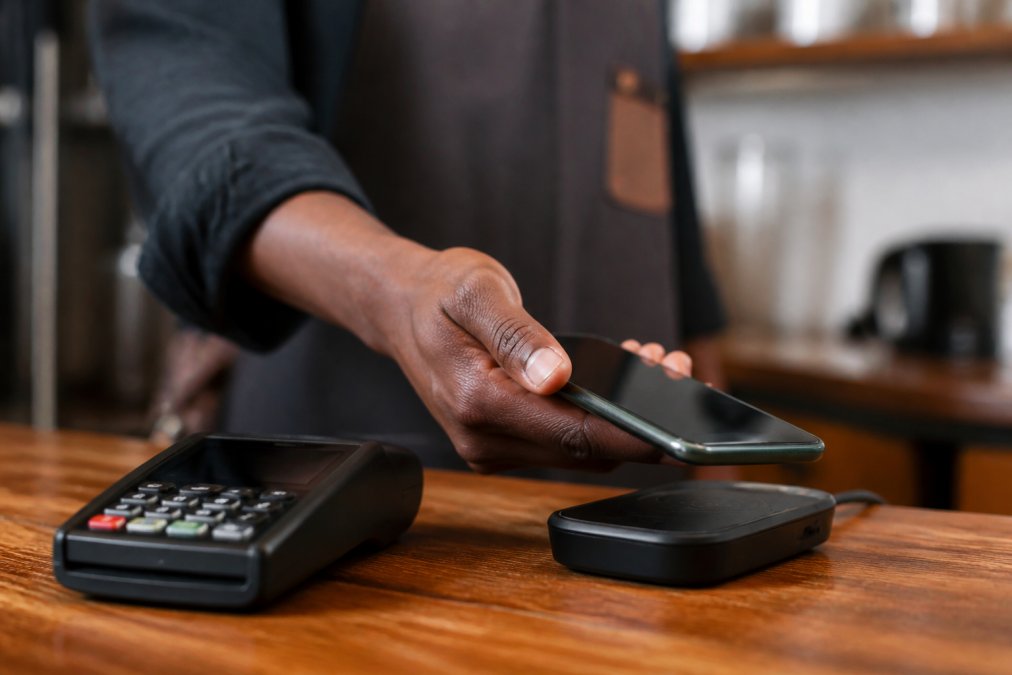
 comparison
Why Use NFC Over Card Readers? A 2026 Busker Guide
Table of Contents
- Why Use NFC Over Card Readers? The Honest Answer
- NFC Does Not Mean One Payment Method
- Seven Reasons Performers Use Passive NFC and QR
- The Limitations You Should Know
- When a Card Reader Is the Better Choice
- The Most Reliable Busking Setup Is Often a Mix
- How Halo Pulse Actually Works
- Security, Fees and Supporter Trust
- Frequently Asked Questions
- Conclusion: Choose the Payment Journey, Not the Buzzword
Last updated: September 20, 2026
Why Use NFC Over Card Readers? The Honest Answer
If you are asking why use NFC over card readers, the first thing to know is that NFC is a technology, not a single payment product. A contactless card reader uses NFC. Tap to Pay on a compatible phone also uses NFC. A passive NFC tag can use the same technology simply to open a secure web link.
For a street performer, the real choice is usually between three different approaches:
Approach | What the supporter taps | What happens next | Best suited to |
|---|---|---|---|
Passive NFC and QR display | Their smartphone | A support checkout opens on their phone | Self-service tips and ongoing artist discovery |
Tap to Pay on phone | Their card, phone or watch against the performer's phone | The performer's payment app processes an in-person transaction | Active, face-to-face sales without a separate reader |
Dedicated card reader | Their card, phone or watch against the reader | The terminal processes an in-person transaction | Frequent sales, fixed prices and point-of-sale workflows |
A passive NFC display is not a card reader. It cannot charge a bank card directly and it does not receive payment credentials. Its advantage is different: it gives supporters a visible, battery-free doorway to the artist's own mobile checkout.
NFC Does Not Mean One Payment Method
The NFC Forum describes NFC as a short-range wireless technology used for payments, access, pairing and smart-poster interactions such as opening a web address. Those uses can look similar from the outside—a person taps something—but the underlying transaction is not the same.
Passive NFC link
A small NFC tag stores a web address. When a compatible phone is held near the tag, the phone offers to open that link. The tag has no battery, no mobile-data connection and no payment application. The supporter completes the next steps on their own phone.
Tap to Pay on a phone
With Tap to Pay, a compatible merchant phone becomes the acceptance device. The supporter presents a contactless card, phone or watch to the performer's phone. Availability depends on the performer's country, handset and payment provider.
Dedicated contactless reader
A dedicated reader accepts contactless credentials and communicates with a payment service. It usually requires power and either its own connection or a paired phone. EMVCo maintains specifications for interoperable card-based contactless payments, but the provider still determines supported devices, fees and offline rules.
Seven Reasons Performers Use Passive NFC and QR
1. There is nothing to charge
A passive NFC tag and printed QR code require no battery. That removes one common failure point from a long day of performing. The supporter's phone provides the power for the NFC interaction and the connection for the checkout.
2. Support can be self-service
A card reader normally requires the performer to start or supervise the transaction. A clearly labelled NFC and QR display can remain visible while the artist keeps singing, playing or creating. The supporter chooses when to approach and completes the process privately.
3. The performer's phone stays available
Many artists already use their phone for backing tracks, filming, set lists, messages or navigation. A passive display does not turn that phone into a counter terminal for every supporter.
4. One tap can lead to more than payment
A well-designed support journey can show the correct artist identity, suggested amounts and a route back to the artist's public profile. The street encounter can continue through music, video, social links and future appearances instead of ending with an anonymous transaction.
5. The entry cost can be lower
An artist can begin with a printed QR code rather than purchasing a reader. The physical NFC display can be added later without changing the basic checkout journey.
6. QR provides a second way in
NFC is quick, but not every supporter knows where the antenna sits on their phone or has NFC available. A QR code beside the tap point gives them a familiar alternative.
Important: QR is a fallback for opening the link, not for an internet outage. Both NFC and QR need the supporter's phone to reach the online checkout.
7. The physical setup can stay simple
There is no Bluetooth pairing, terminal cable or powered screen. For performers who move between pitches, fewer components mean less to configure and less to forget.
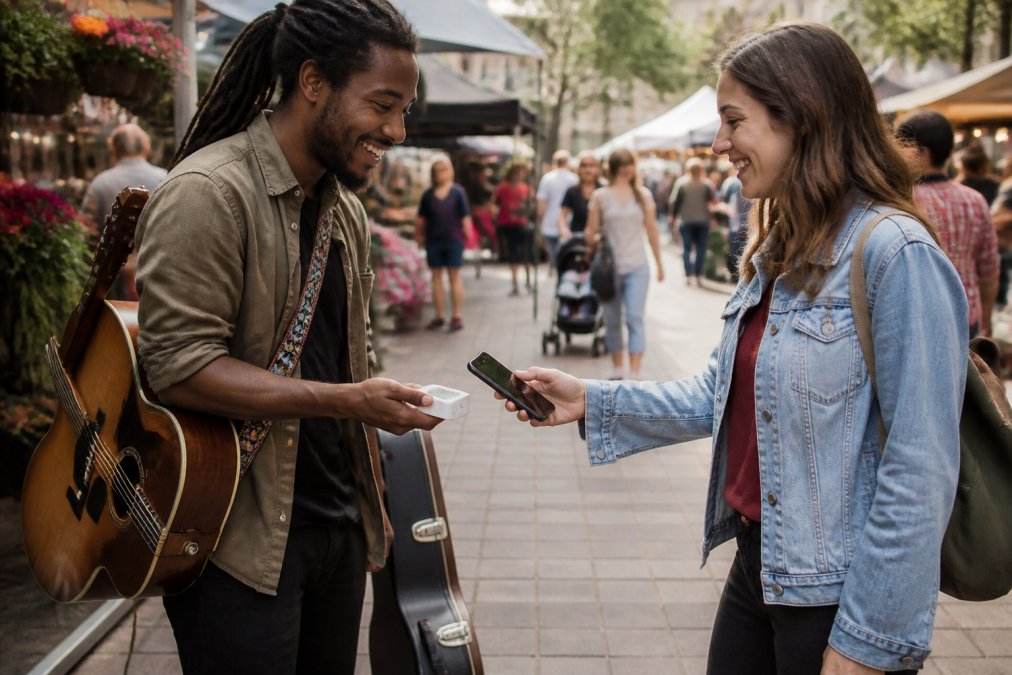
A passive NFC display opens the artist's checkout on the supporter's own phone; it does not read a bank card directly.
The Limitations You Should Know
The case for NFC and QR is strongest when its limits are stated plainly.
- The supporter needs a compatible phone. A passive NFC tag cannot accept a physical card by itself.
- The checkout needs internet access. The NFC handshake is local, but the webpage and payment still require mobile data or Wi-Fi.
- The payment is not completed at the tap. The supporter must open the notification, choose an amount and authorise payment.
- Wallet availability varies. Payment options depend on country, device, browser and the artist's connected provider.
- Public displays must be checked. Inspect the QR and NFC destination regularly so a damaged or substituted label is noticed quickly.
These are not reasons to avoid passive NFC. They are reasons to present it accurately and keep another payment option available.
When a Card Reader Is the Better Choice
A contactless reader remains valuable when you are selling something with a clear price and actively completing the sale. It may be the better option when:
- You sell merchandise, prints or CDs throughout the day.
- The supporter has a bank card but does not want to use their phone.
- You need a conventional point-of-sale record for each item.
- You want to enter the amount yourself before presenting the reader.
- Your provider supports a suitable offline mode and you understand its limits and risk.
A reader does not automatically mean a monthly terminal fee; pricing models vary. Compare the actual hardware cost, per-transaction fee, payout timing and country availability of the providers you can use.
The Most Reliable Busking Setup Is Often a Mix
The practical answer is rarely “NFC or card reader forever.” Different supporters prefer different methods. A resilient street setup can combine:
- A passive NFC and QR display for visible, self-directed support.
- Cash for people without a compatible phone or connection.
- An optional reader or Tap to Pay if you regularly sell fixed-price items.
The right mix depends on the performance. A singer receiving voluntary support has a different workflow from a visual artist selling ten numbered prints or a musician running a busy merchandise table.
How Halo Pulse Actually Works
Halo Pulse uses the passive NFC-and-QR model. The flow is deliberately simple:
- The artist places Halo Pulse and the accompanying QR display where supporters can see and reach them.
- A supporter taps Halo Pulse with a compatible smartphone or scans the QR code.
- The artist's support checkout opens on that phone.
- The supporter selects a suggested amount or enters a custom amount.
- They authorise payment using the options available through the connected provider.
- They can continue to the artist's profile and discover more of their work.
Halo Pulse does not read bank cards, contain a powered payment terminal or create an offline payment. That is precisely why it needs no charging or pairing.
Security, Fees and Supporter Trust
With a passive NFC link, the tag contains a URL rather than card information. Payment details are entered into the connected provider's checkout, not into Halo Pulse. Supporters should still confirm the correct artist name and secure web address before authorising payment.
My Fedora artist profiles and downloadable support QR codes are free. My Fedora takes 0% platform fee from the artist's support. Standard payment-processing fees may still apply through the artist's connected provider.
At checkout, a supporter may be offered an optional way to maximise their support by helping cover processing costs and contributing to keeping My Fedora free for artists. That contribution is voluntary; it is not required to support the artist.
Frequently Asked Questions
Can someone tap a bank card directly on Halo Pulse?
No. Halo Pulse is tapped with a compatible smartphone. It opens the artist's support checkout on that phone; it is not a contactless bank-card reader.
Does passive NFC work without Wi-Fi?
The tag itself does not need Wi-Fi, power or mobile data, but the supporter's phone needs an internet connection to load the checkout and complete payment.
Is NFC better than a card reader for every performer?
No. Passive NFC is excellent for visible, self-service support. A card reader can be better for frequent fixed-price sales or supporters who prefer to present a physical card. Some performers will benefit from carrying both.
Why provide both NFC and a QR code?
They offer two ways to open the same support journey. NFC is quick and tactile; QR is familiar and works when a phone does not detect the tag easily. Neither replaces the need for internet access.
Does My Fedora charge artists a subscription or platform fee?
No. The artist profile and downloadable QR code are free, with no My Fedora platform fee deducted from artist support. Payment-provider processing fees may apply, and supporters can choose an optional contribution at checkout.
Conclusion: Choose the Payment Journey, Not the Buzzword
The best answer to “why use NFC over card readers?” is not that NFC is always faster, safer or more reliable. Card readers already use NFC. The real advantage of a passive NFC-and-QR system is that it creates a visible support point without a powered terminal, keeps the performer's phone free and lets the supporter complete the journey independently.
If you need direct card acceptance for active sales, use a reader or a supported Tap to Pay service. If you want an always-visible doorway to support and artist discovery, begin with NFC and QR. Many performers will sensibly use both.
Create your free artist profile and download your free QR code