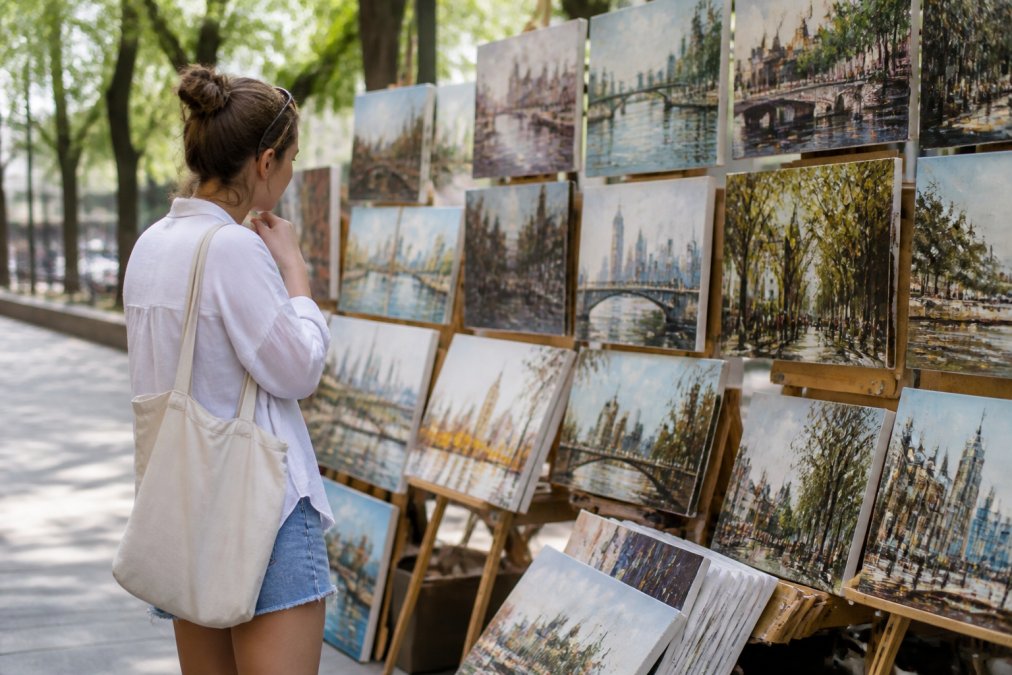
 how-to
How to Showcase Art on Street: A 2026 Guide
Table of Contents
- Step 1: Decide What “Showcasing” Means for You
- Step 2: Check Permission for the Exact Place and Activity
- Step 3: Choose a Place Where People Can Stop Safely
- Step 4: Build a Portable Street-Art Display
- Step 5: Make Prices and Payments Obvious
- Step 6: Turn a Passing Viewer Into a Lasting Connection
- Step 7: Plan for Weather, Safety and Pack-Down
- Step 8: Protect Your Work and Keep Records
- Frequently Asked Questions
- Conclusion: Make the Street Display Easy to Understand
Last updated: September 20, 2026
Learning how to showcase art on street is not simply a matter of leaning a few canvases against a wall. A strong outdoor display has to attract attention without blocking the public space, survive ordinary weather, communicate prices clearly and give people a way to find the artist again.
The best setup is not necessarily the biggest. It is the one you can transport, assemble safely, supervise alone and repeat consistently.
Step 1: Decide What “Showcasing” Means for You
Before researching permits or buying display equipment, define what you intend to do. These activities can be treated differently by councils, venue operators and land managers:
- Displaying finished work without selling it.
- Creating art live while people watch.
- Accepting voluntary support for a live artistic activity.
- Selling originals, prints or merchandise.
- Taking commissions or deposits for future work.
Do not assume a busking permit automatically allows retail sales, or that permission to paint on a legal wall allows you to hang work, install a booth or trade beside it. Describe your actual activity when asking for approval.
Step 2: Check Permission for the Exact Place and Activity
Rules are local. A public footpath, council-managed square, privately owned laneway, market and festival can each have a different decision-maker. Start with the local council or the owner and operator of the site.
Ask these questions before committing to the location:
- May I display artwork here?
- May I sell work or accept commissions?
- Does live painting fall under a busking or performance permit?
- Is a separate street-trading, market or event approval required?
- What footprint, trading hours and signage limits apply?
- Is public liability insurance required, and at what level?
- Are easels, tables, marquees, weights or temporary structures permitted?
Get the answer in writing where possible and keep it accessible on the day. Application timeframes, fees and insurance requirements vary, so avoid universal claims about what “most councils” demand.
Watch out: A legal graffiti wall is permission to create work on a specified surface under its rules. It is not automatically a retail pitch, exhibition wall or permission to attach framed pieces.
Step 3: Choose a Place Where People Can Stop Safely
High foot traffic is useful only if people can pause without obstructing everyone else. Look for a location with:
- Enough dwell space for two or three people to browse.
- A clear sightline from the direction people approach.
- Protection from strong wind, harsh glare or sudden rain.
- Good natural light without prolonged direct sun on delicate work.
- No conflict with doorways, ramps, tactile paving, emergency access or neighbouring traders.
- A position you can supervise while talking to visitors.
Visit the spot at the same time and day you plan to use it. A laneway that looks ideal on a quiet morning may become a delivery route at lunch. A sunny square may turn into a wind tunnel in the afternoon.
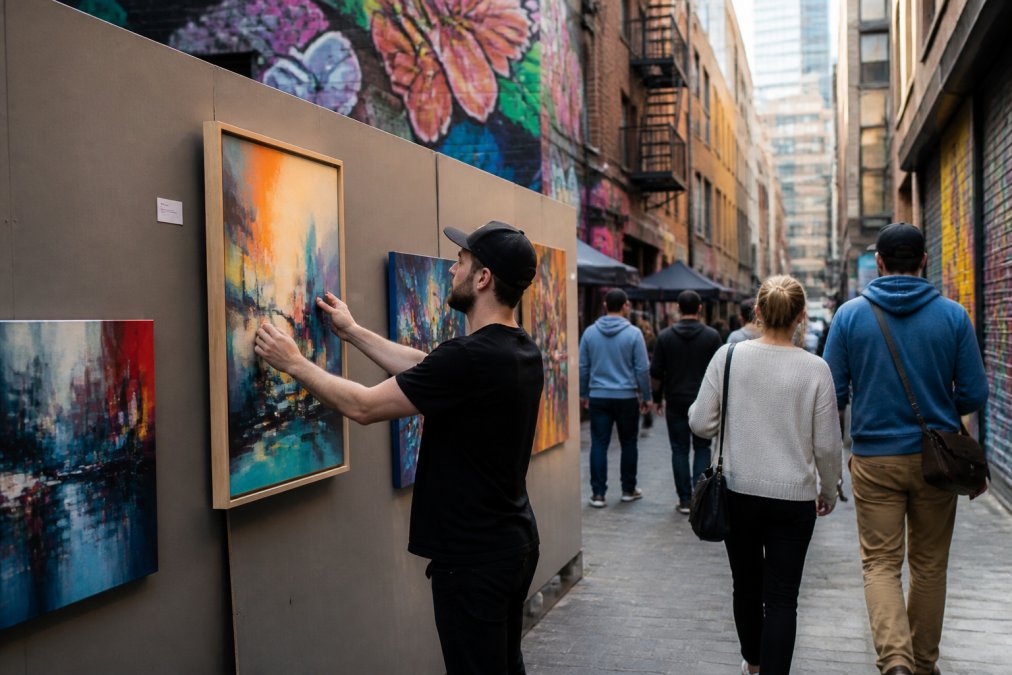
A good street-art location combines visibility with enough safe space for people to stop and browse.
Step 4: Build a Portable Street-Art Display
Your display should communicate three things from several metres away: this is original art, it belongs to a real artist, and visitors are welcome to look.
A practical solo setup may include:
- One or two folding grid panels, stable easels or compact display boards.
- Weights positioned low and inside the display footprint.
- Clips or closed hooks appropriate for the weight of each piece.
- Clear sleeves or protective covers for prints.
- A small table or crate for packaged work, if the site allows it.
- A weather cover you can deploy quickly.
- A clear artist sign, price labels and payment instructions.
- A trolley or case that lets one person move the entire setup.
Display option | Strength | Trade-off |
|---|---|---|
Grid panels | Flexible layout and quick artwork changes | Need secure feet and low weights |
Easels | Professional presentation for a few feature pieces | Limited capacity and vulnerable to bumps |
Portfolio racks or crates | Compact way to browse protected prints | Less visible from a distance |
Marquee | Shade and overhead rain protection | Large footprint, more weight and possible permit restrictions |
Build and pack the display at home before taking it onto the street. If you cannot assemble it safely by yourself, simplify it or arrange help. Never rely on improvised weights, loose cords or artwork attached to property without permission.
Step 5: Make Prices and Payments Obvious
People are often reluctant to ask a price. Label each original or print clearly, and distinguish between:
- Original work.
- Limited or open-edition prints.
- Framed and unframed prices.
- Commission availability.
- Voluntary support for live creation or demonstration.
Offer more than one payment route where practical.
Payment option | Useful for | Remember |
|---|---|---|
Cash | Small sales and no-signal locations | Keep change and cash secure |
Card reader or Tap to Pay | Fixed-price sales completed with the artist | Check power, connection and provider availability |
QR or passive NFC checkout | Self-service support and phone-based payment | The supporter's phone needs internet access |
A QR or NFC display should lead directly to the correct artist checkout rather than a general homepage. Show the artist name and image on-screen so the visitor can confirm the destination before paying.
My Fedora lets artists create a free profile and download a free support QR code. Halo Pulse adds a dedicated passive NFC-and-QR touchpoint; it opens checkout on the visitor's phone rather than reading a bank card directly.
Step 6: Turn a Passing Viewer Into a Lasting Connection
The street display may last a few hours, but the relationship should not have to end when you pack it away. Give every interested visitor one obvious route back to you.
- Use the same artist name on your sign, profile and social accounts.
- Display one QR code prominently instead of competing codes for every platform.
- Add a short sentence explaining what the visitor will find after scanning.
- Keep profile images and featured work current.
- List future markets, exhibitions or street appearances where possible.
- Include a simple way to enquire about commissions.
A public artist profile can carry the story behind the work, a gallery, videos, social links and appearances in one place. That is more useful than asking a visitor to remember a username shouted across a busy footpath.
Step 7: Plan for Weather, Safety and Pack-Down
Outdoor displays fail through wind far more dramatically than through a lack of decoration. Keep the centre of gravity low, secure every piece independently and define a weather threshold at which you will pack down.
Your pre-opening check should include:
- Nothing protrudes into the walking path.
- Weights cannot roll, slide or create a trip hazard.
- Frames and hooks cannot fall if one panel is bumped.
- Packaging and covers are reachable without leaving the display unattended.
- The payment sign and QR code remain readable.
- You can pack everything quickly if conditions change.
If the permit, organiser or site owner requires public liability insurance, confirm that the policy covers the actual activity, location and temporary structure. Do not assume a studio policy covers street trading.
Step 8: Protect Your Work and Keep Records
In Australia, copyright generally arises automatically when original artistic work is created, but copyright law and available remedies vary by country and circumstance. Keep dated high-resolution files, progress photographs, invoices and edition records that help establish authorship and provenance. The Arts Law Centre of Australia provides specialist resources and legal services for artists.
For every sale, record:
- The work or edition sold.
- The gross sale price.
- Payment-processing or platform costs.
- Any delivery, framing or commission obligations.
- The date and location of the sale.
Only collect customer information you genuinely need, store it securely and obtain permission before adding anyone to marketing communications.
Frequently Asked Questions
Do I need a permit to showcase art on the street?
Possibly. The answer depends on the location and whether you are displaying, creating, busking, selling or installing a structure. Contact the relevant council, land manager, market or event organiser and describe the complete activity before setting up.
Can I sell art beside a legal graffiti wall?
Not automatically. Permission to paint a legal wall applies to that wall and its published conditions. Selling art, attaching a display or occupying nearby public space may require separate approval.
What is the best portable display for a solo artist?
A small number of stable easels or folding grid panels, weighted low and paired with protected prints, is a practical starting point. Choose a setup you can transport, assemble and pack safely without assistance.
How can people pay for art outdoors?
Offer cash plus at least one digital route. A card reader or Tap to Pay works well for active fixed-price sales. A clearly labelled QR or passive NFC display lets visitors open a phone-based checkout and can also connect them with the artist's profile.
How do I make people remember my art after they leave?
Use a consistent artist name, one prominent profile link and a clear reason to scan. Your online profile should show the work, story, social links and future appearances that help a passing viewer reconnect later.
Conclusion: Make the Street Display Easy to Understand
A successful street-art display is legal for the exact activity, stable in the real conditions and understandable at a glance. Start small: permission, a safe display, clear prices, more than one payment option and one memorable route back to the artist.
Once that simple version works, improve it using real observations. Notice where people stop, which pieces attract questions, which payment route they choose and how long pack-down takes. The street will show you what the display needs next.
Create your free artist profile and download your free QR code