 how-to
How to Increase Busking Income: 8 Practical Tips
Last updated: 28 September 2026
Increasing your busking income starts with understanding what happens between someone hearing your performance and choosing to support it.
Can they stop comfortably? Does your performance hold their attention? Is it obvious how to leave a tip? And after travel, payment fees and other expenses, which sessions actually earn you the most?
There is no reliable formula that guarantees a particular income. Weather, location, audience, performance style and timing all matter. However, you can improve your setup and measure which changes make a difference.
Here are eight practical places to start.
1. Measure Your Earnings Before Changing Your Setup
Start with a simple record of each session. Without a baseline, it is easy to mistake a busy crowd or one unusually generous tip for a lasting improvement.
What to record | Why it helps |
|---|---|
Location, date and time | Helps identify useful pitches and time slots |
Actual performance time | Makes sessions of different lengths easier to compare |
Cash and completed digital tips | Shows your total recorded income |
Payment fees and direct session costs | Helps you understand what you retain |
Weather and unusual events | Adds context to unusually strong or weak results |
One change you tested | Helps connect a result with a specific adjustment |
Track tips per performance hour alongside earnings after direct costs. You can also include travel and setup time when deciding whether a pitch is worth returning to. Record gross digital tips before fees, then deduct those fees once so you do not count the same cost twice.
For example, imagine a session brings in $100 in tips, with $20 in combined payment fees and direct session expenses. That leaves $80 before tax and other business costs. If you performed for two hours, that is $40 per performance hour after those costs. If travel and setup brought the total time to four hours, it is $20 per working hour.
Those figures are an illustration, not an estimate of typical busking earnings.
The underlying principle is straightforward: income alone does not show profitability. The Australian Government’s profit-and-loss guidance explains how recording income and expenses helps you understand business performance.
2. Choose a Pitch Where People Can Stop Comfortably
A crowded street is not automatically a good busking location. People rushing through a narrow walkway may have little opportunity to stop, even if they enjoy what they hear.
Look for a permitted location where:
- People can see and hear you before reaching your setup.
- An audience can gather without obstructing access.
- Your equipment and tipping display fit safely.
- Nearby noise does not overwhelm your performance.
- Your sound is appropriate for surrounding businesses, residents and other performers.
Check local rules before testing a new pitch. For example, the Australian Government’s City of Melbourne busking permit listing states that a permit is required for busking in a road or public place. Melbourne’s busking handbook also addresses audience management, access and sound. Requirements vary by location, so check the authority responsible for your chosen space.
Compare several sessions at similar times before deciding that one location is better. A festival crowd, sudden downpour or nearby construction can distort a single result.
3. Make Your Set Easy to Join
Street audiences often arrive halfway through a performance. Your set needs to make sense to someone who has just walked into earshot.
Think about the experience from their perspective:
- Is there a clear performance happening?
- Can they quickly understand your style?
- Are there long gaps while you search for tracks or adjust equipment?
- Is there a satisfying moment that makes staying worthwhile?
Prepare your opening material and rehearse transitions. Keep essential equipment within reach so small adjustments do not repeatedly interrupt the set.
For musicians, you might test different opening songs or the balance between original and familiar material. For other performers, consider how clearly you introduce an act and how naturally it builds towards its conclusion.
There is no universal set list that earns the most. The useful question is which structure suits your performance and helps your particular audience stay engaged.
4. Make the Tipping Instructions Obvious
Someone should not need to interrupt you to find out how to offer support.
A useful display includes your artist name, a short invitation and clear instructions for each payment option.
For a QR code, try:
Enjoying the music? Scan to support.
For a smartphone NFC access point, try:
Tap your phone or scan the QR code to support.
Naming the phone matters. A vague “tap here” sign can lead people to assume they should tap a bank card.
Keep the display readable and uncluttered. Test the QR code from a comfortable distance, check for glare and make sure the destination belongs to the correct artist.
A brief spoken invitation can also help:
“Thanks for listening. If you’d like to support the set, you can leave cash or scan the sign.”
Keep it welcoming and optional. People should feel comfortable enjoying the performance whether or not they contribute.
5. Offer Cash and a Clear Digital Support Route
Offering more than one way to contribute gives your audience a choice. It does not guarantee higher earnings, but it removes the need for every supporter to use the same method.
Cash remains useful for people carrying it and for situations without internet access. A QR code or smartphone NFC link can give other supporters a route to an online checkout.
How My Fedora and Halo Pulse Fit In
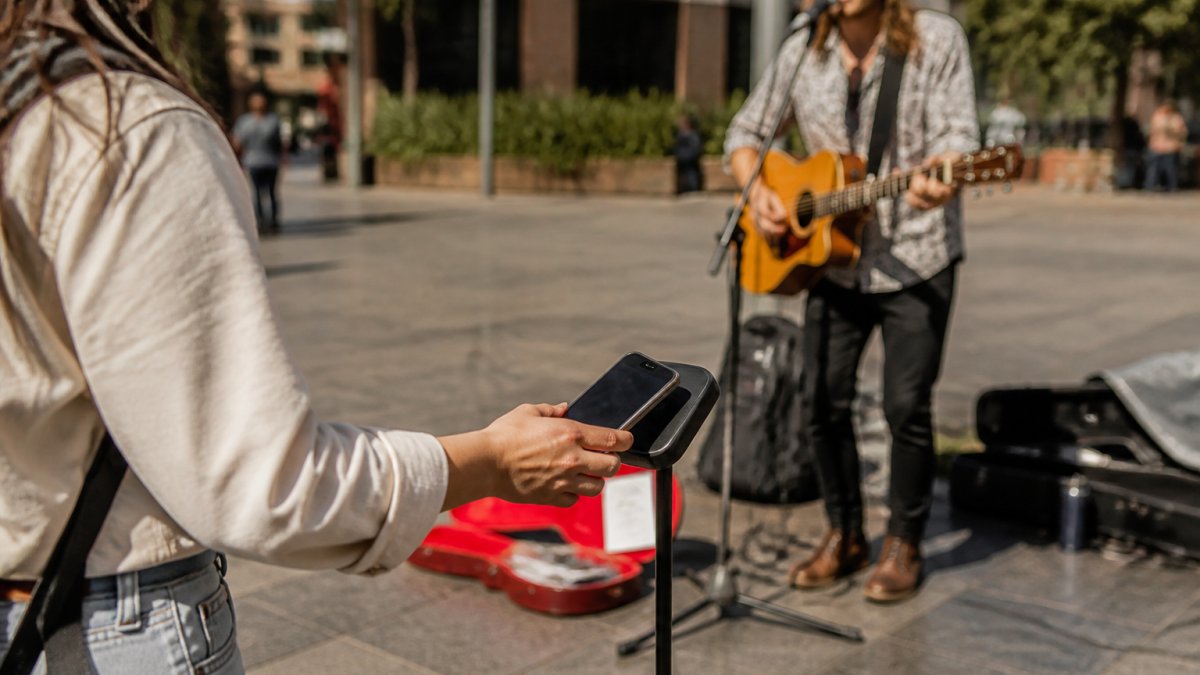
My Fedora gives artists a way to direct supporters to their online support checkout. Artists can display their official QR code, while Halo Pulse provides a smartphone NFC/QR access point: a supporter taps with a compatible phone or scans the QR code, then completes the checkout online.
Halo Pulse is not a bank-card reader. It does not accept a debit or credit card tapped against it, store card details or create, queue or settle offline transactions. The supporter’s phone needs an internet connection.
The performer does not need to supply venue Wi-Fi for a supporter who has working mobile data. However, if the supporter cannot get online, the checkout cannot be completed at that moment.
My Fedora deducts 0% from the selected artist-support amount. Ordinary payment-provider fees may apply. Any additional supporter contribution to My Fedora is optional and unchecked by default.
Before performing, test that your displayed link opens the correct checkout. For more detail on connectivity, see how to accept tips without Wi-Fi. For setup guidance, read how to set up NFC tap payments for street performers.
6. Reduce Interruptions and Keep the Audience Comfortable
Reliable preparation helps you spend more of your session performing.
Before leaving, check the equipment you actually depend on: instruments, cables, batteries, backing tracks, stands and your tipping display. Pack sensible spares for small items that regularly cause problems.
At the pitch, listen from the audience’s position if possible. Aim for clear, comfortable sound rather than simply increasing volume.
Build breaks into your plan, particularly during long sessions or difficult weather. A shorter, well-delivered performance may be more useful to test than extending a session after your voice, energy or concentration has dropped.
Keep your support display visible during the performance, and secure your cash and equipment when you pause or pack up.
7. Help People Remember Your Artist Name
A contribution today and an ongoing audience connection are separate opportunities.
Use a consistent artist name on your sign, profile and public pages. Someone who enjoyed the performance should be able to find you again without remembering a complicated handle.
If you maintain a page with music, performance updates or booking information, give interested listeners a clear way to reach it. My Fedora brings an artist’s story, work and social links into one profile, alongside their support checkout.
Keep the immediate support instruction prominent. A sign crowded with competing links can make a simple action harder to understand.
Do not assume a payment automatically creates a follower, mailing-list subscriber or permission to contact someone. Let people choose whether they want an ongoing connection.
8. Test One Change at a Time
Once you have a baseline, choose one adjustment and compare several reasonably similar sessions.
Useful tests include:
- Moving your tipping sign to a more visible position.
- Simplifying the wording beside your QR code.
- Changing the opening section of your set.
- Trying a different permitted time slot.
- Giving one brief support invitation at a consistent point.
If you change the location, repertoire, display and session length together, it becomes difficult to tell what helped.
Look beyond the single best result. Compare typical sessions and note unusual circumstances, including large individual tips.
Your next-session plan can be simple:
- Choose one thing to test.
- Prepare and check the equipment.
- Record performance time, completed tips and direct costs.
- Note anything unusual about the session.
- Repeat before deciding whether to keep the change.
The aim is to develop a setup that works consistently for your act and your regular locations.
Give Your Audience a Clear Way to Support You
A stronger busking setup combines an engaging performance, a suitable pitch and clear support instructions. Track the results so you can keep improving what works for your audience.
My Fedora provides an online support route for your artist profile, with QR access and an optional Halo Pulse smartphone NFC/QR access point. Supporters complete checkout on their own internet-connected phones.
Start free with My Fedora and set up your artist support profile.
Frequently Asked Questions
What is the best first step to increase busking income?
Record several sessions, including performance time, tips and direct costs. Then look for a clear problem you can address, such as poor sign visibility, frequent equipment interruptions or a location where people cannot comfortably stop.
How much can a busker earn per hour?
There is no dependable universal hourly figure. Earnings vary with location, timing, performance, weather and audience. Your own records provide a more useful planning basis than someone else’s best session.
Will accepting cashless tips increase my earnings?
It may help people contribute when they do not have cash, but an increase is not guaranteed. The checkout needs to be easy to find and use. Compare completed tips across several similar sessions to understand the effect on your act.
Can supporters tap a bank card on Halo Pulse?
No. Halo Pulse is a smartphone NFC/QR access point. It opens the artist’s online checkout on the supporter’s phone. It is not a contactless bank-card terminal.
Can Halo Pulse collect tips without internet access?
The supporter’s phone needs internet access to load the checkout and complete payment. Halo Pulse does not store or queue offline payments. Cash can remain an option when connectivity is unavailable.
Does My Fedora take a percentage of artist support?
My Fedora deducts 0% from the selected artist-support amount. Ordinary payment-provider fees may apply. Any additional supporter contribution to My Fedora is optional and unchecked by default.