 listicle
7 Professional Tools for Street Performers in 2026
Table of Contents
- What Makes a Tool Professional for Street Performance?
- 1. A Battery-Powered Amplifier That Suits Your Real Set
- 2. A Durable Dynamic Microphone and a Spare Cable
- 3. A Folding Trolley and an Organised Transport System
- 4. A Redundant Power and Charging Kit
- 5. A Weather and Cable-Safety Kit
- 6. A Sound-Level Meter and Hearing Protection
- 7. A Digital Support and Artist-Discovery System
- How to Build Your Kit Without Overspending
- Frequently Asked Questions
- Conclusion: Build a Rig That Fails Gracefully
Last Updated: September 22, 2026
The best professional tools for street performers are not necessarily the most expensive. They are the tools that reduce failure points: dead batteries, unsafe cables, damaged equipment, excessive volume, missed support and a setup that takes too long to move.
A professional street rig should be portable enough to manage alone, dependable for the full session and simple enough that one fault does not end the day. The seven tools below cover sound, transport, power, weather, safety and the audience journey after someone stops to watch.
What Makes a Tool Professional for Street Performance?
Street performance places different demands on equipment from a rehearsal room or indoor venue. There may be no power outlet, no sound engineer, no roof and no secure backstage area. Every item has to justify its weight.
Before buying anything, ask five questions:
- Can I carry and set it up safely? A brilliant system is useless if it requires a second person you do not have.
- Will it last through my real set? Test runtime at performance volume with every device connected.
- What happens when it fails? A spare cable, battery or printed QR can rescue a session.
- Does the location allow it? Amplification, structures, signage and trading may be regulated separately.
- Does it improve the audience experience? Equipment should help people hear, stop safely, support you or find you again.
Key takeaway: Professional means repeatable. Build a rig you can set up, test, supervise and pack down the same way every time.
1. A Battery-Powered Amplifier That Suits Your Real Set
A battery-powered amplifier is the centre of many music and spoken-word setups. The right model is not simply the loudest. It provides enough clean output for the permitted space, accepts the sources you actually use and runs long enough at realistic volume.
The Roland CUBE Street II is a well-known example because it combines portable amplification with separate inputs for a microphone and instrument. It is not automatically the best choice for every performer. A vocalist with backing tracks, a keyboard player and a duo all need different inputs, monitoring and power.
Check these points before buying:
- The number and type of microphone, instrument and auxiliary inputs.
- Whether both performers in a duo can control their channels independently.
- Battery type, replacement cost and realistic runtime at your normal volume.
- Total weight once batteries, stand, cables and covers are included.
- Whether the output is appropriate for the local amplification rules.
Raise or tilt the speaker toward the listening area instead of driving it from ground level at maximum volume. Better placement often improves clarity more than additional power. Never assume a portable amplifier is rainproof unless its manufacturer explicitly says so.
2. A Durable Dynamic Microphone and a Spare Cable
For outdoor vocals, a wired dynamic microphone is often the dependable choice. It avoids wireless battery and interference problems, tolerates ordinary handling and connects to most portable amplifiers with a standard XLR cable.
The Shure BETA 58A is one professional example. Shure specifies a supercardioid pickup pattern, a hardened steel mesh grille and a vocal-focused response. Its tighter pickup pattern can help reject sound arriving off-axis, but microphone and speaker placement still matter. A supercardioid microphone has different rejection angles from a cardioid model, so follow the manufacturer's polar diagram rather than placing the speaker or monitor by habit.
Your microphone kit should include:
- One microphone that suits your voice and gain requirements.
- A reliable stand with a stable base and a clip that fits correctly.
- Your primary XLR cable plus one tested spare.
- A foam windscreen for wind noise—not as permission to perform in rain.
- A dry pouch or case for transport.
Audition microphones through the amplifier you plan to use. A model that sounds excellent in a quiet shop may respond differently beside traffic, reflective walls and another loud performer.
3. A Folding Trolley and an Organised Transport System
A trolley may be less exciting than a new microphone, but it often produces the biggest practical improvement. Carrying an amplifier in one hand, an instrument in the other and loose bags over both shoulders is slow, tiring and difficult to control in a crowd.
Choose a trolley or cart that:
- Handles the complete loaded weight with a safety margin.
- Has wheels suited to kerbs, paving gaps and the surfaces on your route.
- Can be restrained with straps rather than loose elastic cords.
- Folds or parks inside your performance footprint.
- Keeps valuable and weather-sensitive items accessible.
Pack by setup order. The stand, cable mat and amplifier should not be buried beneath the items you need later. Use labelled pouches for audio, power, payment signage and weather protection, and keep a simple inventory inside the case.
Pro tip: Perform one complete setup and pack-down at home with a timer. If small items repeatedly disappear or the trolley has to be unpacked twice, change the layout before the next street session.
4. A Redundant Power and Charging Kit
Power failure is predictable, which makes it preventable. Do not rely on the battery percentage shown after a quiet home test; audio equipment draws more power at performance volume, and phones work harder when they are navigating, filming, streaming or searching for signal.
A practical power kit can include:
- A power bank from a reputable manufacturer with enough capacity for the phone and accessories you actually connect.
- Spare batteries of the correct type for the amplifier, pedals or accessories.
- Short, clearly labelled charging leads plus one spare for the most important device.
- A small battery tester where replaceable cells are used regularly.
- A dry, padded pouch that keeps loose batteries separated and protected.
Run a full-duration rehearsal and record which batteries were used, the starting charge and the remaining charge. Replace damaged leads and swollen or overheating batteries immediately, and follow the manufacturer's charging and transport instructions.
Your phone should not be the single point of failure for directions, music, contact details and payments. Save the address, permit information and emergency contact details locally before leaving.
5. A Weather and Cable-Safety Kit
Weather protection is not one large tarp thrown over everything. It is a small set of items that lets you protect equipment quickly and remove trip hazards before the public reaches them.
Pack:
- A fitted cover or waterproof bag for the amplifier and electronics during transport and pack-down.
- Microfibre cloths for hands, connectors and cases.
- Low-profile cable covers or mats appropriate for the site.
- Reusable cable ties for excess cable length.
- Weights designed for the stand or display you use.
- Resealable dry bags for documents, batteries and small electronics.
Route cables inside your footprint, not through the path where the audience approaches. Keep connectors off wet ground. If conditions threaten electrical safety or make stands unstable, stop and pack down; a cover is not a licence to continue through heavy rain, strong wind or lightning.
Check the forecast and the site, but also watch conditions during the set. Tall signs, umbrellas and speaker stands can become unstable long before the performer feels unsafe.
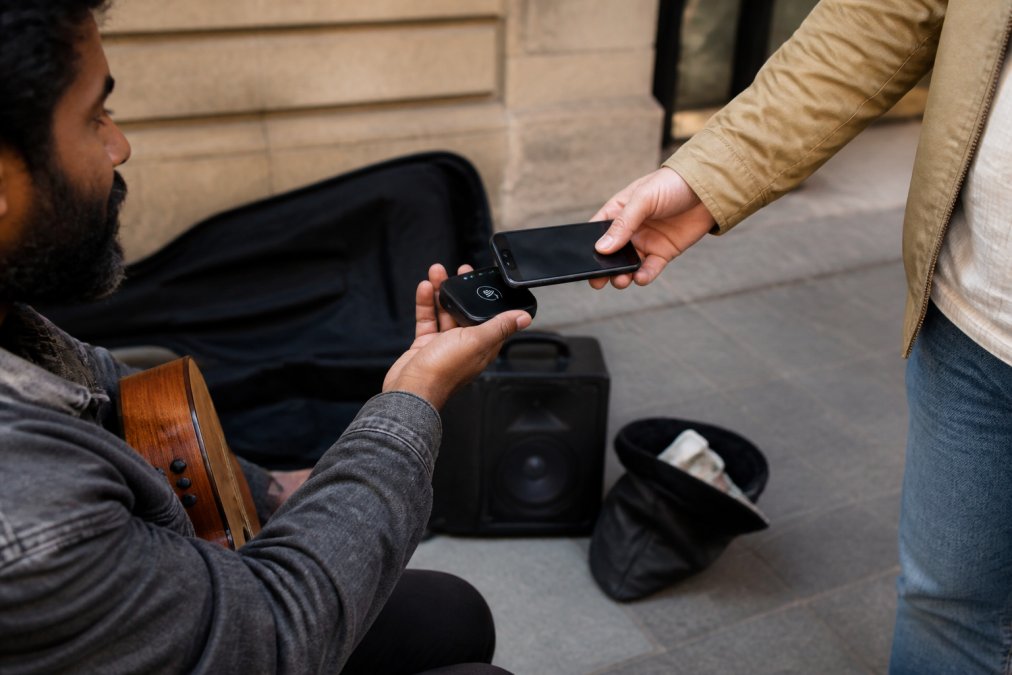
A professional setup makes sound, support and safe movement easy to understand at a glance.
6. A Sound-Level Meter and Hearing Protection
A sound-level meter helps you replace guesswork with a repeatable check. It does not decide whether the performance is lawful—the local permit, site conditions and authorised officers do—but it can reveal when the rig is louder than expected or when a location is already noisy before you begin.
The free NIOSH Sound Level Meter app is available for iOS. NIOSH says it has been tested and validated, although a phone app should not be presented as a council-certified compliance reading. Android hardware varies, so use a dedicated calibrated meter where accurate measurements are required.
Measure from representative audience positions rather than directly beside the speaker. Record the level at your normal setting and repeat the check when the crowd, traffic or speaker position changes.
Protect your own hearing as well. Musician-style earplugs are designed to reduce level more evenly than basic foam plugs, helping preserve tonal balance. Choose genuine hearing protection with published attenuation information and learn how to fit it correctly.
Watch out: Turning up to overpower traffic usually reduces clarity, increases feedback risk and raises the chance of complaints. A different position or speaker angle may solve the problem more effectively.
7. A Digital Support and Artist-Discovery System
A professional setup gives people a clear way to support the artist and find them again. Cash can remain part of the mix, but a visible digital option matters when the audience is carrying phones rather than coins.
My Fedora combines a free artist profile with an official support QR. The profile can hold the artist's story, work, social links and appearances, while the QR leads into that artist's support journey. My Fedora deducts 0% from the amount selected as artist support; the connected payment provider's ordinary processing fees may still apply. A supporter can choose an optional, unchecked contribution at checkout.
Halo Pulse is the physical tap-to-support access point connected to that system. It is important to describe it accurately:
- Halo Pulse is tapped with a compatible smartphone; it is not a bank-card reader.
- The tap opens the artist's support checkout on the supporter's phone.
- The supporter chooses an amount and pays through the available connected provider.
- The phone needs internet access to load checkout and complete payment.
- Halo Pulse itself does not store card details or create an offline transaction.
While Halo Pulse progresses toward its first production release, eligible artists can create a free profile and claim an official early-access support QR. Printed, laminated QR displays and holders are also available for performers who want a ready-to-use street display.
Position the QR or tap point where it is visible, reachable and still under your control. Add a short instruction—such as “Tap or scan to support”—and make sure the artist name and image shown after opening match the performer in front of the supporter.
How to Build Your Kit Without Overspending
Build around the failure that is currently costing you the most, not the item that looks most impressive online.
Current problem | First upgrade | Do not forget |
|---|---|---|
People cannot hear clearly | Speaker placement, then the appropriate amplifier | Local amplification rules and hearing safety |
Vocals disappear or feed back | Microphone technique, placement and a suitable dynamic mic | A tested spare XLR cable |
The rig is exhausting to move | Trolley and modular packing system | Loaded weight and kerb clearance |
Sessions end with dead devices | Measured power plan and spares | Full-volume runtime testing |
Rain or cables create chaos | Weather and cable-safety kit | A clear pack-down threshold |
People watch but cannot support or reconnect | Free artist profile and official support QR | Clear signage and a working checkout test |
Buy one layer at a time and test it on the street before adding the next. A smaller system that you understand completely is more professional than an elaborate rig with untested dependencies.
Frequently Asked Questions
What equipment does a new street performer actually need?
Start with the tools required for the performance itself, safe transport, weather protection and a clear way for people to support or find you. Amplification is only essential when the act and local rules make it appropriate. Add equipment after real sessions reveal a specific problem.
Is the Roland CUBE Street II the best busking amplifier?
It is a well-known portable option, but there is no universal best amplifier. Compare inputs, weight, battery system, sound character, expected audience size and local volume restrictions. Test your microphone or instrument through the amplifier before buying where possible.
Can Halo Pulse accept a card or complete a payment offline?
No. Halo Pulse is a tap-to-support access point for compatible smartphones, not a contactless bank-card reader. It opens the artist's checkout on the supporter's phone, and that phone needs internet access to complete payment.
How should a busker prepare for weak mobile signal?
Download directions and permit information before leaving, keep important contact details locally and test coverage at the spot. A printed QR and Halo Pulse can provide two ways to open the same support journey, but neither can load an online checkout without a connection on the supporter's phone.
Do professional tools remove the need for a busking permit?
No. Equipment does not grant permission. Check the rules for the exact location and activity, including amplification, selling, structures, signage and public liability insurance. Requirements vary between councils, land managers, markets and events.
Conclusion: Build a Rig That Fails Gracefully
The most useful professional tools for street performers solve predictable problems. The amplifier and microphone make the performance clear. The trolley, power kit and weather kit keep it moving. Sound checks protect the audience and the performer. A visible digital support and artist-discovery system gives the street encounter somewhere to continue.
Start with the weakest part of your current setup, add one dependable solution and carry a backup for anything that could end the session. That is what turns a collection of gear into a professional street rig.
Create your free My Fedora artist profile and claim your official support QR